
LUHO Plastic Surgery explains the principles of under-eye fat repositioning surgery, the TTL technique involving tear trough ligament release, the role of preoperative ultrasound assessment, and the recovery process.
November 12th, 2026

When under-eye fat begins to bulge or the tear trough becomes more pronounced,
the eyes may appear dark, tired, or aged, even when you are well-rested.
Dark circles can develop for several reasons, including pigmentation,
protruding fat, thin skin, and hollowing beneath the eyes.
When there is a noticeable difference in height between protruding
under-eye fat and the hollow tear trough, skincare products alone may not be enough to address the concern.
Under-eye fat repositioning is a surgical procedure designed to reduce this structural unevenness by moving and securing protruding orbital fat into the hollow tear trough area.
Located near Sinsa Station in Gangnam, Seoul, LUHO Plastic Surgery develops
individualized surgical plans based on the distribution of
under-eye fat and the condition of the tear trough ligament.

Dark circles and under-eye puffiness can generally be associated with
three main factors: protruding orbital fat, tear trough hollowing, and changes in the skin.
As the tissues supporting the fat around the eyes become weaker, orbital fat may begin to protrude forward.
This can create visible under-eye bags and cast shadows along the lower eyelid.
The tear trough ligament is one of the anatomical structures that help support the tissues beneath the eyes.
When there is a noticeable difference in height between surrounding tissues,
the tear trough may appear deeper, making the boundary beneath the eyes more prominent.
Dark circles may also result from thin under-eye skin, pigmentation, or visible blood vessels.
Because these factors are not primarily caused by fat distribution,
under-eye fat repositioning alone may not fully address them.
Under-eye fat repositioning may be considered when dark circles are mainly caused by
protruding orbital fat and structural hollowing along the tear trough.

Under-eye fat repositioning aims to smooth the transition beneath
the eyes by moving protruding fat into hollow areas.
However, adjusting the position of the fat alone may not always be sufficient.
In some cases, the condition of the tear trough ligament and
surrounding supporting tissues must also be considered.
At LUHO Plastic Surgery, the TTL (Tear Trough Ligament) under-eye fat repositioning technique
involves evaluating the ligament and surrounding tissues,
releasing adhesions where necessary, and repositioning the orbital fat.
When the tear trough ligament contributes to a pronounced under-eye groove,
carefully releasing the affected tissues may help create a smoother contour beneath the eyes.
Comparison | Fat Repositioning-Focused Approach | LUHO TTL Under-Eye Fat Repositioning |
|---|---|---|
Surgical focus | Repositioning protruding orbital fat | Considering both fat distribution and tear trough ligament condition |
Tear trough ligament | Release and treatment determined by individual anatomy | Releasing ligament adhesions when necessary |
Fat fixation | Securing repositioned fat in an appropriate position | Planning fat repositioning and fixation according to tissue condition |
Preoperative assessment | Clinical examination and additional testing when indicated | Clinical examination supported by ultrasound findings |
Expected improvements | Reduced fat protrusion and under-eye unevenness | Smoother tear trough transition and reduced structural shadows |
Note: Conventional under-eye fat repositioning may also involve tear trough ligament release or treatment of the orbital septum. These approaches should not be regarded as entirely separate procedures. Differences generally relate to individualized surgical planning and the extent of tissue treatment.
Ligament release and fat fixation cannot completely prevent recurrence.
As the skin and supporting tissues continue to change with age,
long-term results may vary from person to person.

The under-eye area contains several closely connected anatomical structures,
including thin skin, orbital fat, muscles, and ligaments.
Although two patients may have similar-looking under-eye bags,
their underlying fat distribution and tissue conditions can be different.
At LUHO Plastic Surgery, preoperative ultrasound examinations are used to
evaluate certain soft-tissue structures that may be difficult to assess through visual examination alone.
Orbital fat beneath the eyes is divided into several compartments.
Identifying the areas where fat protrusion is most noticeable can help
guide the surgical plan and determine the appropriate treatment area.
Ultrasound imaging can help evaluate visible soft-tissue structures, including their shape and thickness.
However, ultrasound alone cannot precisely quantify the degree of
tear trough ligament adhesion or the elasticity of the orbital septum.
The degree of fat protrusion, depth of the tear trough, and condition of the skin are evaluated together to determine the extent of fat repositioning and whether additional tissue treatment may be necessary.
Ultrasound serves as a supplementary diagnostic tool. The final surgical plan is determined through a comprehensive assessment of the patient's anatomy and clinical examination.

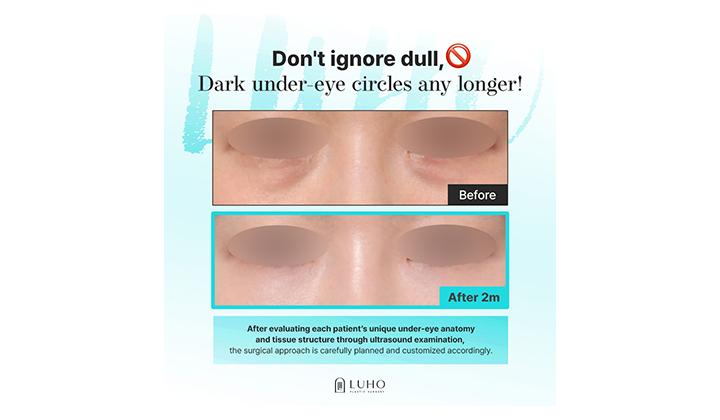
Before-and-after photographs of under-eye fat repositioning can help illustrate changes in fat protrusion,
tear trough definition, and the shadows beneath the eyes.
👉 Before Surgery (Preoperative Assessment)
The orbital septum had weakened, allowing fat in the medial and
central under-eye compartments to protrude forward.
The tear trough ligament was firmly adhered to the surrounding tissues,
creating a pronounced groove beneath the protruding fat.
This uneven distribution of volume produced noticeable under-eye shadows,
particularly under certain lighting conditions, contributing to a tired and aged appearance.
👉 After Surgery (Postoperative Analysis)
Based on the preoperative ultrasound assessment, the adhered tear trough ligament was carefully released,
and the protruding orbital fat was redistributed and secured within the hollow tear trough area.
The difference in height between the under-eye bulge and
the hollow groove was reduced, creating a smoother transition toward the upper cheek.
As the structural shadows became less pronounced, the under-eye area appeared brighter and more even, contributing to a more refreshed appearance.

Q1. How Long Does Swelling Last After Under-Eye Fat Repositioning?When the procedure is performed through an incision inside the lower eyelid, it does not leave an external skin incision scar. Swelling and bruising vary between individuals but often begin to improve gradually during the first 1–2 weeks after surgery. Residual swelling and tissue stabilization may take longer. The appropriate timing for washing your face, exercising, and returning to normal activities depends on the extent of surgery and individual recovery. Patients should follow their surgeon's postoperative instructions. Q2. What Is the Difference BetweenUnder-Eye Fat Removal and Fat Repositioning?Under-eye fat removal focuses on reducing protruding fat, while under-eye fat repositioning moves existing fat into hollow areas to create a smoother contour. When tear trough hollowing is present, removing too much fat may cause the under-eye area to appear more sunken. For this reason, the amount of fat and condition of the surrounding tissues should be carefully considered when planning surgery. Q3. Can Under-Eye Bags Return After Fat Repositioning?Yes. Changes associated with aging may cause under-eye fat protrusion or tear trough definition to become noticeable again over time. Considering the condition of the tear trough ligament and the position of fat fixation may help address structural unevenness. However, no surgical technique can completely eliminate the possibility of recurrence or guarantee how long the results will last. Q4. Can Under-Eye Fat Repositioning Also Improve Dark Circles?When dark circles are primarily caused by shadows from protruding orbital fat and tear trough hollowing, under-eye fat repositioning may help improve their appearance. However, if pigmentation, thin skin, or visible blood vessels are the main causes, fat repositioning alone may not provide sufficient improvement. Q5. What Should I Look for When Choosingan Under-Eye Fat Repositioning Clinic Near Sinsa Station?When considering under-eye fat repositioning, it is helpful to confirm whether the clinic thoroughly evaluates orbital fat distribution and tear trough anatomy before surgery. The surgical approach should be tailored to the patient's individual anatomical structure rather than applying the same technique to everyone. Patients should also consider the qualifications of the plastic surgeon, postoperative follow-up procedures, and the clinic's ability to manage potential complications. |

Under-eye bags and dark circles may look similar from the outside, but their underlying causes can vary.
The most appropriate treatment approach depends on whether the primary concern is protruding orbital fat,
tear trough hollowing, changes in the skin, or a combination of these factors.
At LUHO Plastic Surgery, the anatomical characteristics of the under-eye area are evaluated,
with ultrasound findings incorporated into surgical planning when appropriate.
The TTL under-eye fat repositioning technique is not applied identically to every patient.
Instead, the extent of treatment is determined by considering
the tear trough ligament, orbital fat distribution, and skin condition.

Clinic: LUHO Plastic Surgery
Address: 4F, Sinsa Mi Tower, 616 Gangnam-daero, Gangnam-gu, Seoul, South Korea
Contact: +82-2-516-0013 / +82-2-516-0027
This article is intended to provide general medical information about under-eye fat repositioning surgery.
Surgical outcomes and recovery experiences vary between individuals. Potential complications may include bleeding, infection, asymmetry, under-eye hollowing, and changes in lower eyelid position.
Patients should consult a qualified plastic surgeon before deciding whether to undergo surgery.