
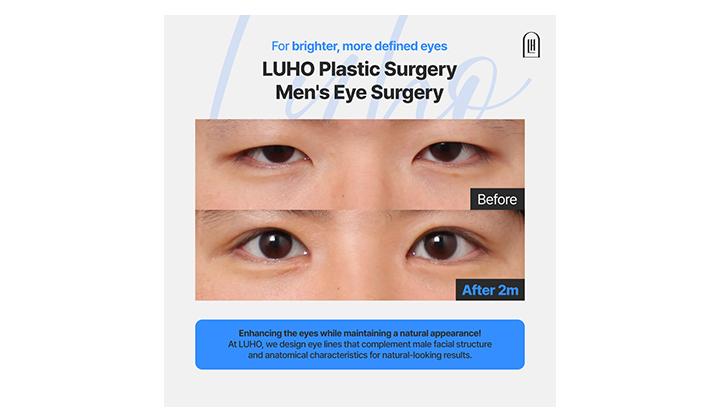
Learn how eyelid skin thickness, fat distribution, and eye-opening function influence double eyelid surgery. Explore non-incisional, incisional, and ptosis correction options at LUHO Plastic Surgery in Seoul.
November 22nd, 2026
When considering double eyelid surgery,
one of the first things people think about is the shape of the eyelid crease.
Some prefer an in-line crease, while others are interested in an in-out or out-line crease.
Many patients also bring reference photos to their consultations to explain their desired appearance.
However, even when the same crease height is used,
the results can look different from person to person.
This is because eyelid skin thickness, fat distribution,
eye-opening function, and natural eye shape vary between individuals.
An eyelid with thicker skin and more underlying tissue may respond differently from one with thinner skin.
The position of the eyebrows and the strength of the muscles responsible
for opening the eyes may also influence how the crease appears.
For this reason, understanding the existing eyelid structure is an essential part of planning double eyelid surgery.
In this article, LUHO Plastic Surgery explains how eyelid anatomy influences surgical planning and what factors may help determine whether non-incisional surgery, incisional surgery, or ptosis correction is appropriate.
Table of Contents
|
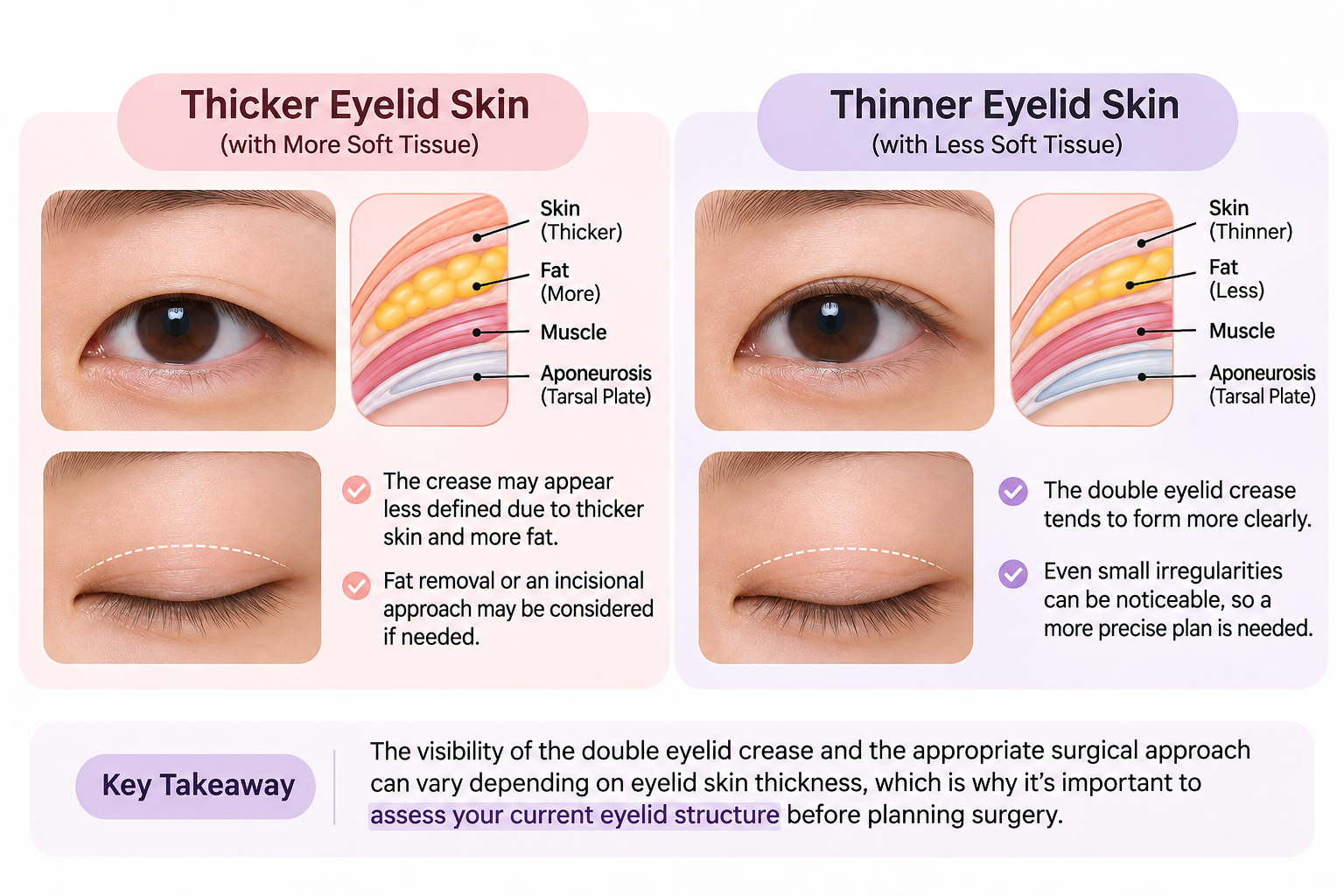
Eyelid skin thickness can influence
how a double eyelid crease forms and how clearly it appears.
Thinner eyelid skin may allow the crease to appear more defined,
while thicker skin may make the same crease height look softer or fuller.
However, eyelid thickness is not determined by the skin alone.
Underlying fat, muscle, and other soft tissues also contribute to the overall appearance.
When the eyelid skin and underlying tissues are relatively thick,
a high or deeply defined crease may create a fuller appearance.
For this reason, the surgeon should assess the thickness and condition of
the eyelid tissues before planning the height and shape of the crease.
The goal is to create a crease that appears balanced when the eyes are open.
With thinner eyelid skin, the crease may appear more clearly defined.
However, small differences in crease position or symmetry may also become more noticeable.
In these cases, both the crease height and the way the skin folds should be carefully considered.
A natural-looking double eyelid crease requires a balance
between the patient's desired appearance and their existing eyelid anatomy.
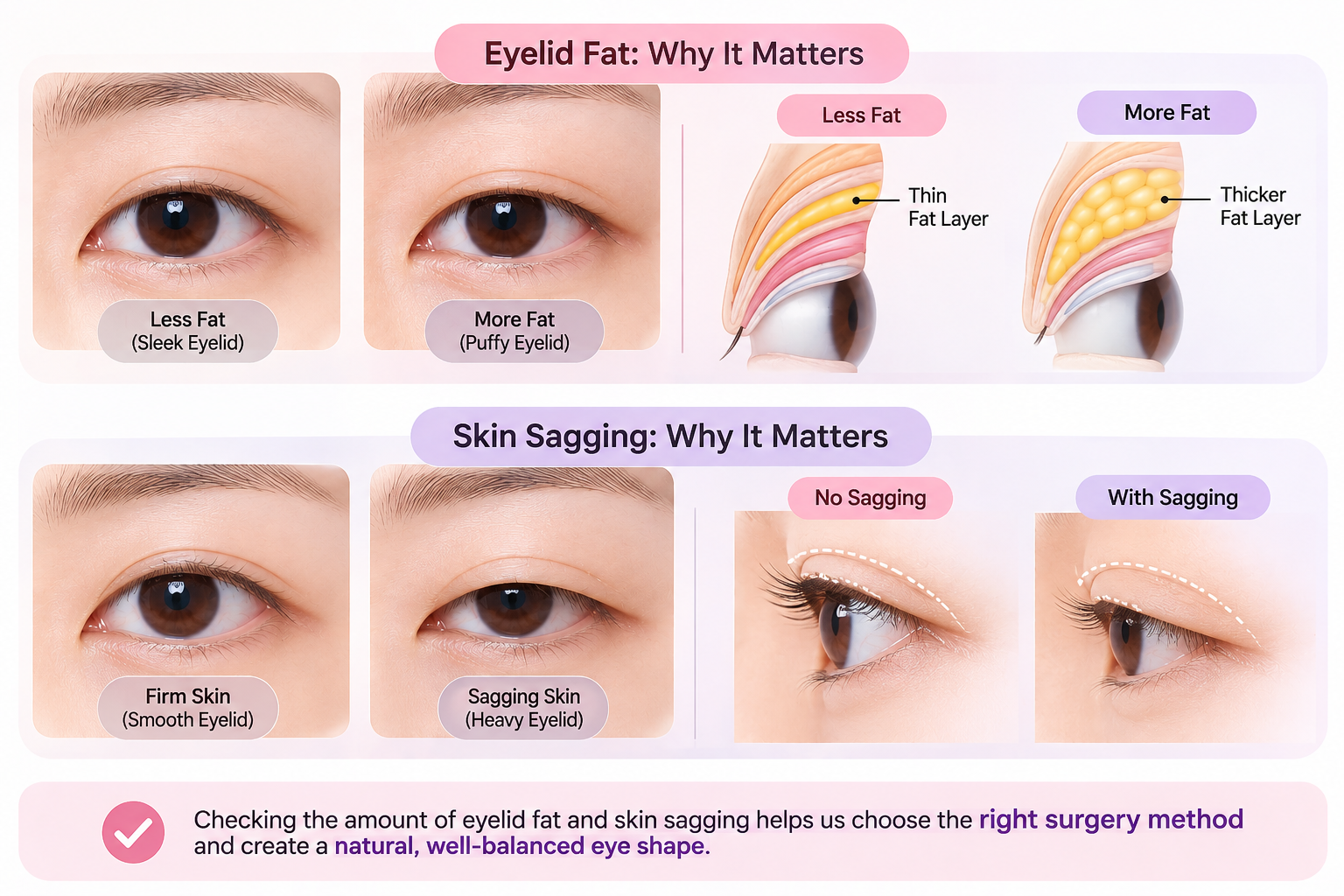
The appearance of the upper eyelids is influenced not only by skin thickness
but also by fat distribution and the amount of excess skin.
A puffy-looking upper eyelid does not necessarily mean there is excessive fat.
The appearance may also be related to naturally thicker skin or the structure of the surrounding tissues.
Conversely, insufficient upper eyelid fat may cause a hollow appearance or multiple eyelid folds.
Therefore, an assessment should consider not only the amount of fat but also its location and distribution.
When the upper eyelid skin becomes loose or begins to sag,
it may partially cover the existing double eyelid crease.
Some patients may also experience a heavy sensation around the upper eyelids.
In these cases, the degree of skin laxity, eyebrow position, and eye-opening habits should be evaluated.
Depending on the findings, additional skin adjustment may be considered alongside double eyelid surgery.
However, skin removal or fat reduction is not necessary for every patient.
Eyelid fat and skin are not tissues that should automatically be removed.
Their function and contribution to the natural eye shape must be considered when planning surgery.
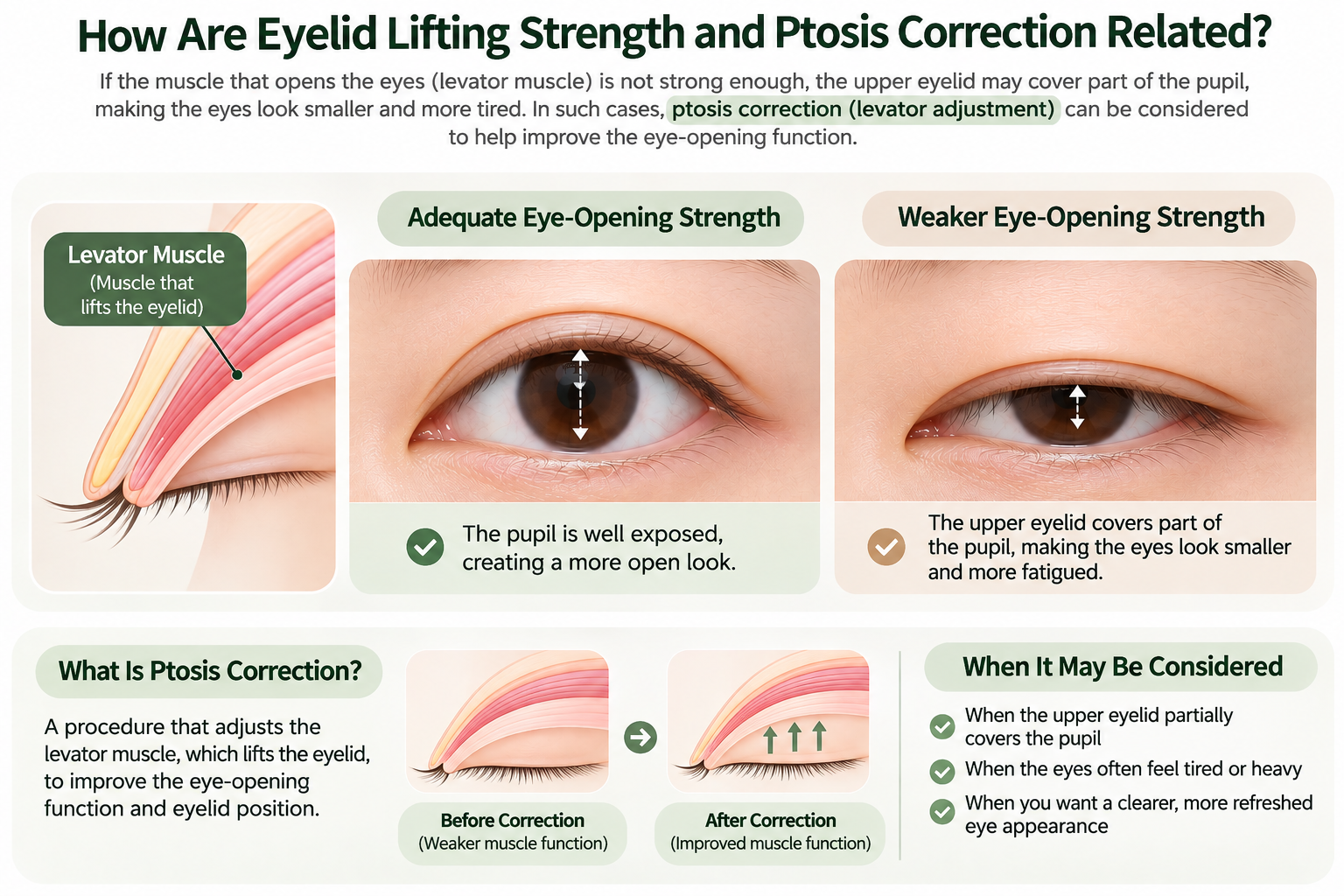
During an eyelid surgery consultation, it is necessary to assess
not only the appearance of the eyelids but also how well they function.
The levator palpebrae superioris muscle, commonly called the levator muscle,
plays a major role in lifting the upper eyelid.
Evaluating the position of the upper eyelid, how much of the iris and pupil are visible,
and whether the patient frequently raises their eyebrows
or uses their forehead muscles can provide useful information.
However, an upper eyelid that appears to cover part of the eye does
not automatically indicate weak levator muscle function.
Excess skin, individual eyelid anatomy, and even facial expression
during photography may affect how open the eyes appear.
Ptosis correction is a surgical procedure intended to improve
the position of the upper eyelid when its lifting function is impaired.
The need for correction should be determined through a clinical examination.
If eyelid-opening function is adequate, double eyelid surgery alone
may be sufficient to achieve the desired crease.
If impaired eyelid elevation is identified,
a procedure that addresses the eyelid-lifting mechanism may be considered.
Ptosis correction is not a necessary part of every double eyelid surgery.
Overcorrection may cause difficulties with complete eyelid closure, dry eyes, or asymmetry.
Therefore, the need for surgery and the appropriate degree of correction must be carefully evaluated.
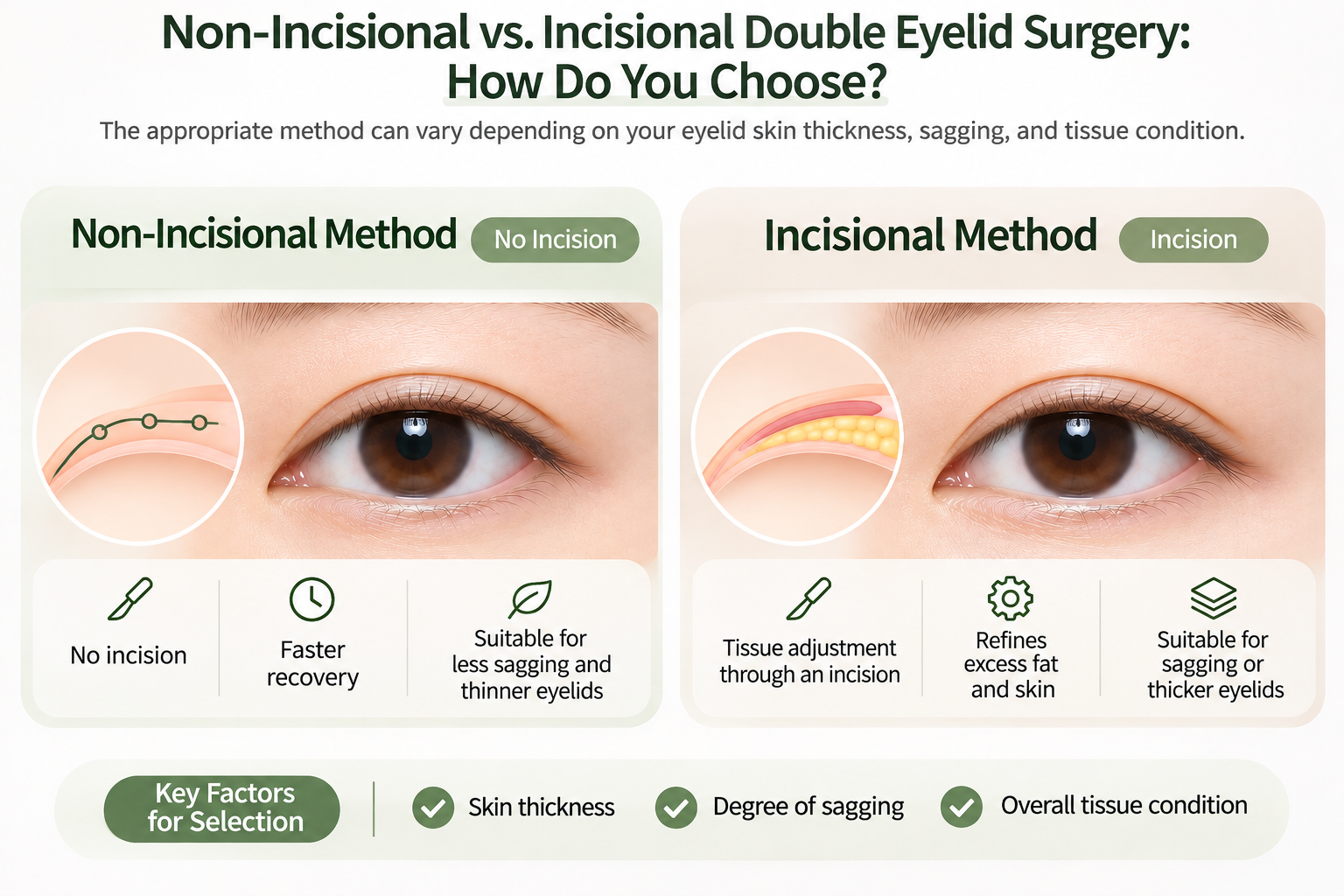
Non-incisional and incisional techniques are two commonly used approaches to double eyelid surgery.
They differ in how the eyelid crease is created and the extent to which underlying tissues can be adjusted.
ategory | Non-Incisional Method | Incisional Method |
|---|---|---|
Surgical Approach | Uses sutures to create connections that form the eyelid crease | Uses an incision to access tissues and create the eyelid crease |
Key Considerations | Skin thickness, skin laxity, and tissue condition | Skin laxity, tissue condition, and need for additional adjustments |
Main Characteristics | Does not require a continuous surgical incision | Allows direct examination and adjustment of tissues when necessary |
Potential Limitations | The crease may weaken or loosen over time | Incision scars and a potentially longer recovery period must be considered |
Non-incisional surgery may be considered when there is minimal excess skin
and the eyelid tissues are suitable for this technique.
However, having thin eyelid skin does not automatically mean
that the non-incisional method is the best option.
The overall eyelid structure and desired crease should also be evaluated.
Incisional surgery may be considered when the eyelid condition requires direct tissue assessment or adjustment.
Depending on the patient's anatomy, this technique may allow the surgeon to
address excess skin or adjust underlying tissues.
However, these additional steps are not necessary in every case.
Neither technique is universally superior. The appropriate surgical approach
depends on the individual's eyelid anatomy and the extent of correction required.
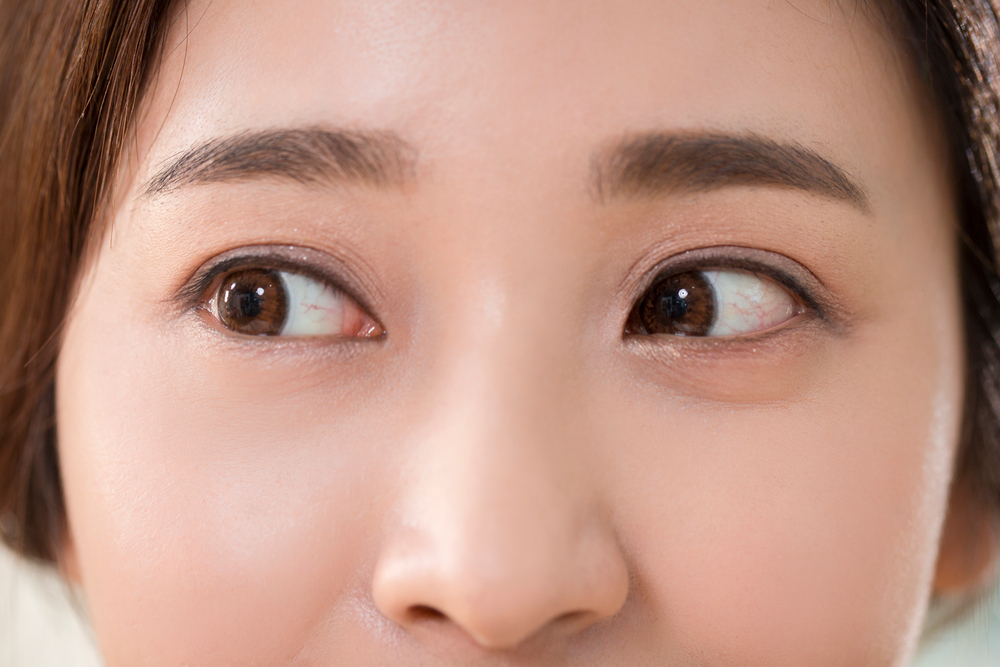
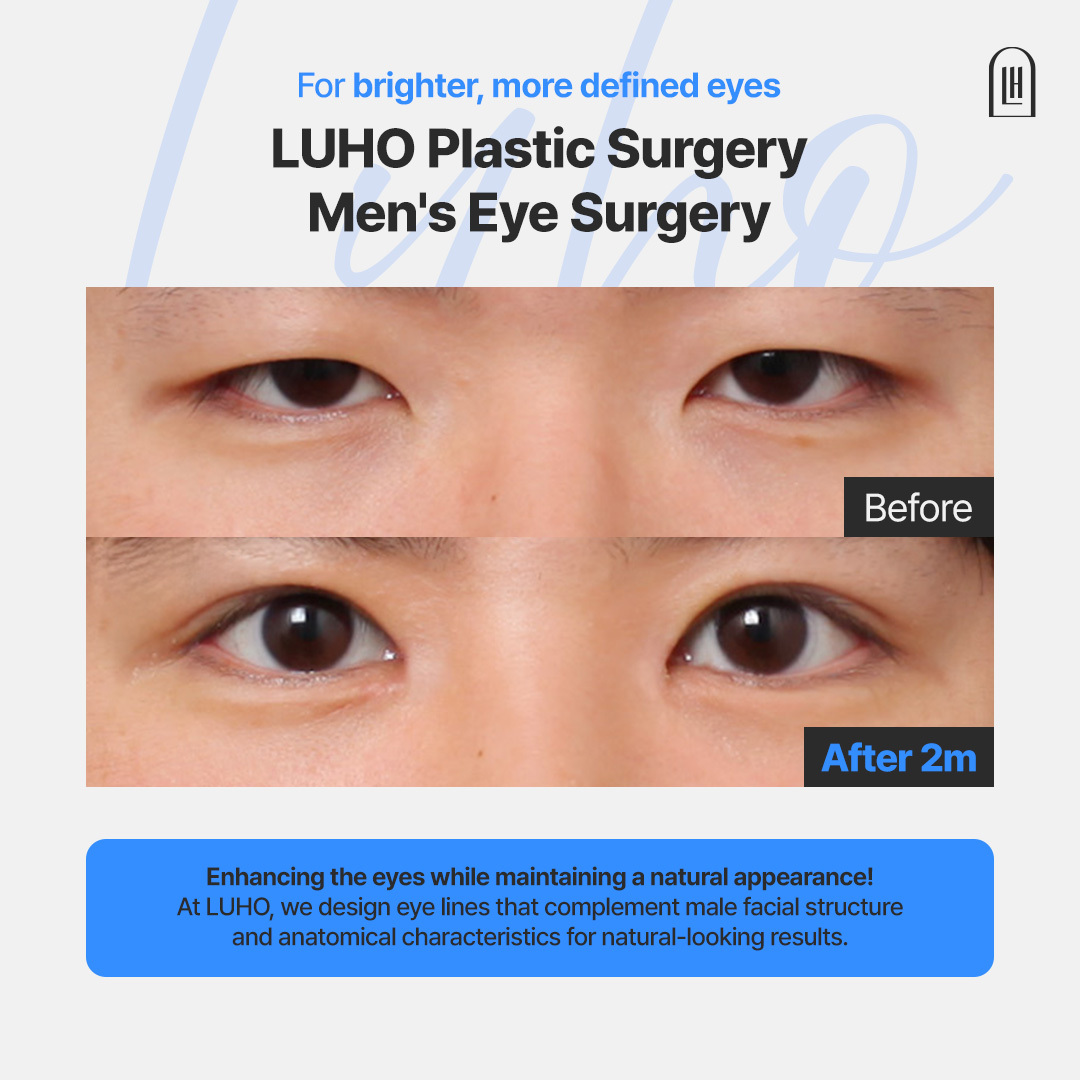
When viewing double eyelid surgery before-and-after photos,
it is easy to focus primarily on the height of the eyelid crease.
However, evaluating the overall change requires consideration of several factors.
Observe how the crease appears before and after surgery
and whether it follows a natural contour from the inner to the outer corner of the eye.
It may also be helpful to compare the appearance of the eyelids when the eyes are open and closed.
Most people have some degree of natural asymmetry between their eyes.
During surgical planning, these differences should be considered
when determining crease height and eyelid position.
Perfect symmetry cannot be guaranteed, and temporary asymmetry may occur during recovery.
Before-and-after photos can help illustrate changes in upper eyelid position and how open the eyes appear.
However, photographs alone cannot determine whether the function of the eyelid-lifting muscles has improved.
Swelling, bruising, tightness, and temporary asymmetry may occur following eyelid surgery.
During the early recovery period, swelling may make the double eyelid crease
appear higher or fuller than expected.
The appearance can continue to change as healing progresses.
For this reason, the time elapsed since surgery and the photography conditions
should be considered when comparing before-and-after results.

Double eyelid surgery may begin with choosing a preferred crease shape,
but the actual surgical plan should consider both eyelid anatomy and function.
Skin thickness, fat distribution, skin laxity, and eye-opening strength differ from person to person.
As a result, the same surgical technique may produce different outcomes depending on individual characteristics.
At LUHO Plastic Surgery, our approach emphasizes evaluating each patient's eyelid condition,
natural eye shape, desired crease, and treatment goals when planning surgery.
Achieving a natural-looking result involves more than choosing the height of the double eyelid crease. It requires selecting an appropriate surgical approach based on the individual's eyelid structure.
This article provides general educational information about double eyelid surgery and ptosis correction.
The appropriate surgical technique and treatment plan may vary depending on individual eyelid anatomy,
eye-opening function, medical history, and previous surgical procedures.
Possible risks include swelling, bruising, scarring, infection, asymmetry,
dry eyes, difficulty closing the eyelids completely, and the need for revision surgery.
Recovery times and surgical outcomes vary between individuals.