
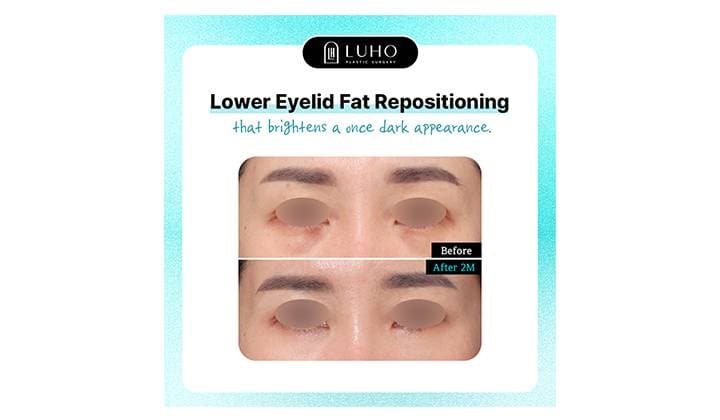
ee how lower eyelid fat repositioning can improve under-eye hollows, puffiness, and dark circles for
August 4th, 2026
As under-eye puffiness and dark circlesbecome more noticeable,
many people begin searching for ‘lowereyelid fat repositioning’.
While there is plenty of informationavailable about pricing and recovery,
it can still be difficult to understandwhat kind of
improvement the procedure can realisticallyprovide.
In this article,
we\'ll review an actualpatient case from
our clinic and explain the keyprinciples
behind lower eyelid fat repositioning and the results that can be achieved.
*All photographs were taken and publishedwith the patient\'s consent.
Surgical outcomes and recovery may varyfrom person to person.
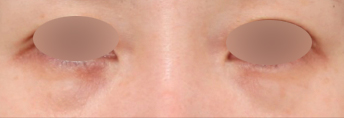
“Before Surgery”
▶️ Shadowing beneath the central lowereyelid
▶️ Uneven contour between the protrudingand hollow areas
▶️ A tired-looking appearance around theeyes
Before surgery, both fat protrusion
and volume deficiency were presentbeneath the eyes.
The upper portion appeared bulging,
while the lower area showed hollowness,creating a noticeable transition
that contributed to the appearance of darkcircles.
Our surgical plan focused on smoothingthe transition
between the protruding and depressedareas,
creating a more continuous contour whilereducing under-eye shadowing.
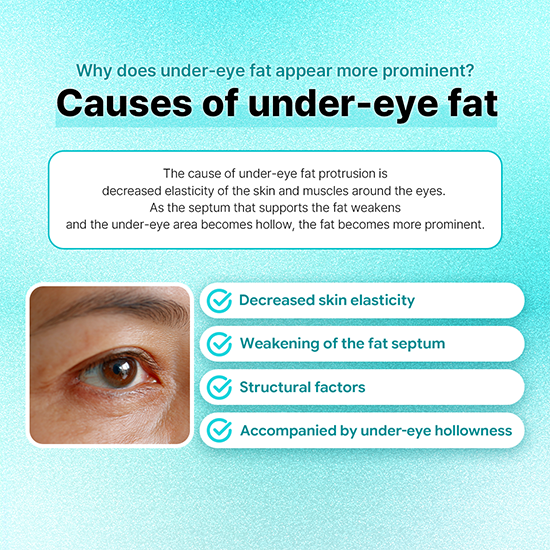
“Why Do Under-Eye Bags
and Hollows Develop?”
The tear trough ligament anchors thelower eyelid structure.
As a result, the fat compartment becomesmore prominent
while the tear trough appears deeper,creating shadows
that often make the eyes look tired.
For this reason, successful lower eyelidfat repositioning
begins with a careful evaluation of theunderlying anatomy.
Releasing the retaining ligament allows theexisting fat
to be redistributed more naturally, helpingcreate a smoother
and more balanced lower eyelid contour.
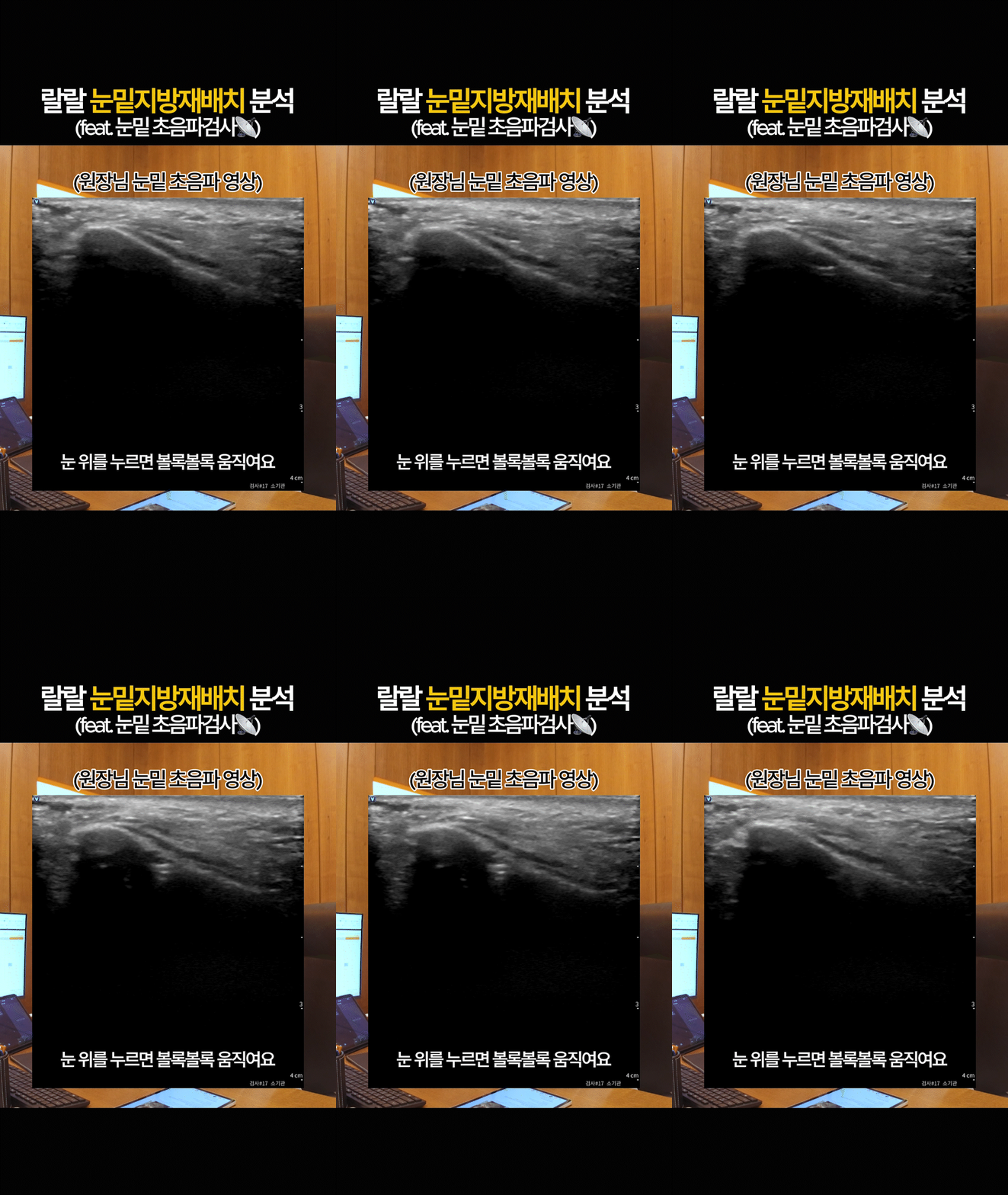
“Every Under-Eye Structure Is Different”
Not every patient has the same under-eyeanatomy.
Some primarily have protruding fat, othershave a deep tear trough,
while many present with a combination ofboth.
One of the most important aspects of
lower eyelid surgery is identifying eachpatient\'s anatomical pattern
and selecting the most appropriatesurgical approach.
At LUHO Plastic Surgery,
we combine ultrasound-based structuralevaluation with
extensive clinical experience todetermine
whether lower eyelid fat repositioningis the most appropriate treatment.
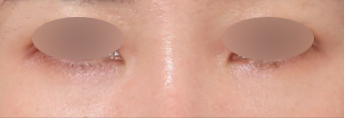
*All photographs were taken and publishedwith the patient\'s consent.
Surgical outcomes and recovery may varyfrom person to person.
“After Surgery”
✴️ Well-balancedunder-eye volume
✴️ A smootherlower eyelid contour
✴️ Brighter,more refreshed-looking eyes
Following surgery, the difference in volume
beneath the eyes was significantly reduced,
allowing the under-eye contour to appearmuch smoother.
As a result, the eye area looks cleaner
and more defined, contributing to a brighter
and morerefreshed overall facial appearance.

Dark circles and under-eye shadowing canmake
the entire face appear tired and dull.
Lower eyelid fat repositioning canimprove uneven contours
and structural shadowing, helping create
a brighter and more youthful appearance.
However,
it is important to note that darkpigmentation caused primarily by
skin pigmentation (hyperpigmentation)cannot be corrected through
lower eyelid fat repositioning alone.

