Hello, this is Luho Plastic Surgery.
• An unnatural eye shape caused by overcorrection
• A sensation that the eyes do not close properly
Many patients experience discomfort due to these issues.
While some hope the problem will improve over time,
concerns often grow as both aesthetic
and functional issues persist.
In such cases, it’s important to understand
what needs to be evaluated
and how the condition should be approached.
Today, we’ll review real cases
where eye revision surgery at Sinsa Station was necessary
due to overcorrection,
and explain how these cases were addressed.
"What Is Overcorrection?"
In eye-opening correction or double eyelid surgery,
overcorrection refers to a condition
where excessive force is applied,
causing the eyes to open too widely.
Common signs include:
• Difficulty closing the eyes easily
• Excessive exposure of the eye vertically
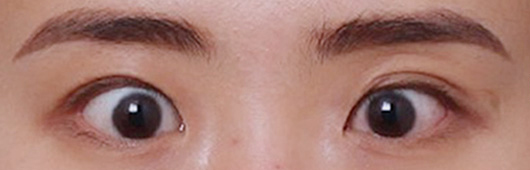
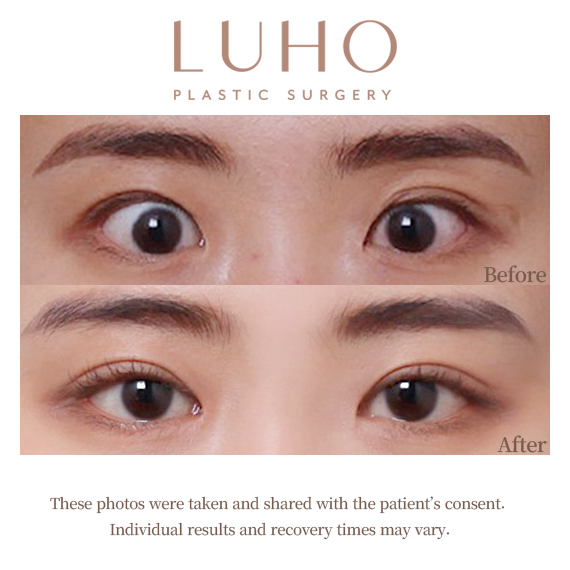
In the preoperative photo of this patient,
a large portion of the sclera (white of the eye) is visible.
Normally, the upper eyelid covers about 1–2 mm of the iris.
If too much sclera is exposed
or the eyes appear constantly wide open,
overcorrection may be suspected.
"Problems Caused
by Overcorrection"
Overcorrection should not be left untreated,
as it can lead to both aesthetic
and functional problems.
Visually, it may create
a startled appearance, a tense expression,
or asymmetry in eyelid opening strength.
Functionally, incomplete eye closure
can cause severe dryness,
corneal irritation,
and a persistent foreign-body sensation.
In particular, eyes that do not fully close during sleep
can significantly increase the risk of dry eye syndrome.
Because overcorrection affects more than appearance,
a professional consultation for eye revision surgery
is strongly recommended.
"First Corrective Approach"
The first approach to improving overcorrection
is adjusting eyelid-opening force
through incisional eye-opening correction.
This involves reducing tension in the muscles
responsible for opening the eyes
and, if necessary, repositioning them
so force is distributed more naturally.
If overcorrection is mild,
eye-opening correction alone may be sufficient.
The key to this approach is accurately assessing
adhesions from previous surgery
and the direction of applied force,
then restoring proper balance.
"Second Corrective Approach"
Another method involves lowering
or redesigning an excessively
high double eyelid line.
In cases of severe overcorrection,
an overly high eyelid line can cause
excessive eye-opening force.
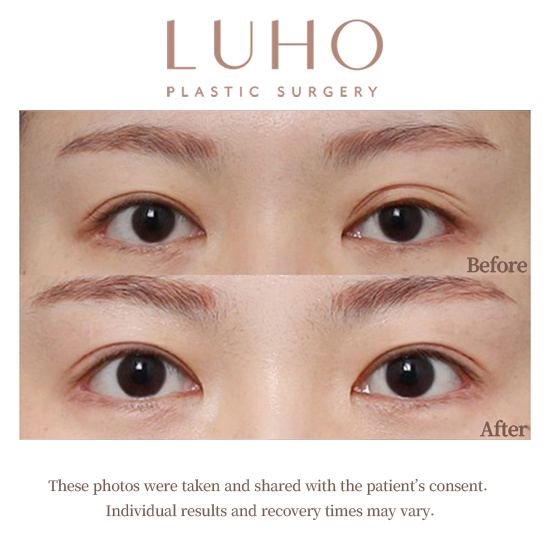
In the preoperative photo,
the eyelid line on the right eye was set too high,
resulting in noticeable imbalance
in eye-opening strength.
Through eye revision surgery to lower the line,
balance between both eyelids was restored.
If the existing line cannot be maintained
or there is damage to eyelid tissue,
a new eyelid line is designed
to reconstruct proper structure.
"When Eye Revision
for Overcorrection Is Needed"
Eyes that have already undergone overcorrection
often present with significant adhesions and scarring,
requiring a surgeon with extensive experience and skill.
Achieving satisfactory results requires more than
simply adjusting the eyelid line.
The surgeon must analyze eye-opening force,
tissue condition,
and the impact of prior surgeries as a whole.
If you are considering revision surgery
due to overcorrection,
we recommend choosing a clinic
that provides meticulous diagnosis
and carefully planned surgical design.