'I thought epicanthoplasty
would make my eyes look clearer,
but instead, I look harsher.'
Epicanthoplasty is a procedure designed
to create a brighter, more open eye shape.
However, over time, some patients
feel the result appears overcorrected.
After surgery,
your appearance may feel unfamiliar,
or your expression may look sharper
or more aggressive than intended.
Especially when the lacrimal caruncle
becomes overly exposed
or scars become prominent,
these concerns can intensify.
For this reason, many people consider
epicanthoplasty revision at Sinsa Station
to restore a natural yet defined eye shape.
In this post, we’ll explain
when epicanthoplasty revision is necessary
and how restoration is performed.
"First Case Requiring Epicanthoplasty Revision:
Excessive Caruncle Exposure"
One of the most common reasons
for epicanthoplasty revision
is excessive exposure of the lacrimal caruncle.
The lacrimal caruncle is the small, pink mucosal tissue
located at the inner corner of the eye,
connected to the tear drainage system.
Before epicanthoplasty,
it is usually partially covered.
However, if the incision range is excessive,
the caruncle can become overly exposed.
This may result in:
• Eyes appearing red or tired
• A sharper, harsher facial impression
• An unnatural inner corner shape
"Second Case Requiring Epicanthoplasty Revision:
Hook-Shaped Deformation"
Another reason for revision
is a hook-shaped or -like inner corner deformity.
This occurs when the inner corner is pulled downward
or the incision direction prodiates
from the eye’s natural curvature.
Scar tissue contraction after epicanthoplasty
can also pull the inner corner line downward.
As a result, the eyes may appear heavy,
sharp, or uncomfortable,
prompting many patients to seek correction.
"Third Case Requiring Epicanthoplasty Revision:
Visible Scarring"
Because the inner corner area has thin and sensitive skin,
even small scars from epicanthoplasty can be noticeable.
If scars harden or the incision area heals unevenly,
the inner corner may appear raised or irregular.
Persistent scars can cause a pulling sensation
when opening the eyes
and become especially visible in close-up photos,
making revision necessary.
"Understanding
the Epicanthoplasty Revision Process"
If you are experiencing any of the issues above,
epicanthoplasty revision may be considered.
However, revision is not simply about
“covering it back up.”
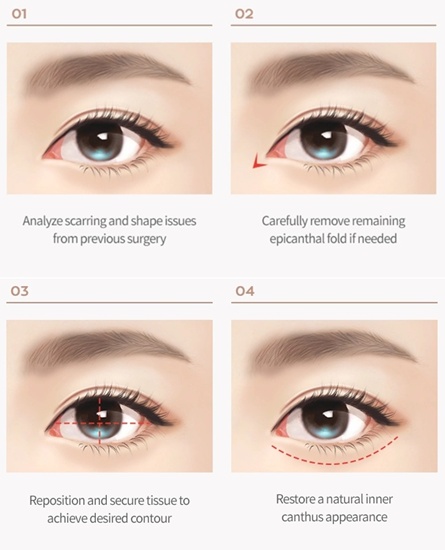
Before revision, careful planning is essential
to determine how to restore a soft, natural eye shape.
• Excessively exposed caruncle tissue is partially covered
• Hook-shaped deformities are reshaped and corrected
• Prominent scars are refined to reduce visibility
The goal is to minimize traces
of the previous epicanthoplasty
and achieve a smooth, natural recovery.
"Epicanthoplasty Revision
at Seoul Sinsa Station:
Luho Plastic Surgery"
Epicanthoplasty revision surgery
is significantly more complex
than the initial procedure.
Because it involves working with previously incised tissue,
advanced surgical design
and delicate tissue handling are essential.
At Luho Plastic Surgery,
we conduct one-on-one analyses to identify
the causes of unsatisfactory epicanthoplasty outcomes
and design angles and shapes
that suit each individual’s facial proportions.
Rather than simply reversing the appearance,
our goal is to restore a softer, more comfortable expression
through precise epicanthoplasty revision
guided by thorough professional consultation.